The Socratic Mind
Where Thinking Becomes Identity
Socratic Entry Essay (Optional, Recommended)
At the Bien-Aimé Institute, we honor the belief that strong thinkers make strong learners.
While our program is designed to support students in tutoring and academic growth, we also offer an optional Socratic Entry Essay experience at the start of enrollment.
This reflective writing activity invites students to:
- explore how they think
- express ideas in writing
- practice academic language
- build confidence in explaining reasoning
Although not required, this process is highly recommended.
It introduces students to the way we support deep thinking and prepares them for the kind of dialogue that strengthens both literacy and mathematical reasoning.
Some families choose tutoring only.
Others elect to incorporate our Socratic practice to support intellectual development and long-term learning habits.
Both pathways are welcome —
and every student receives individualized support based on their needs and goals.
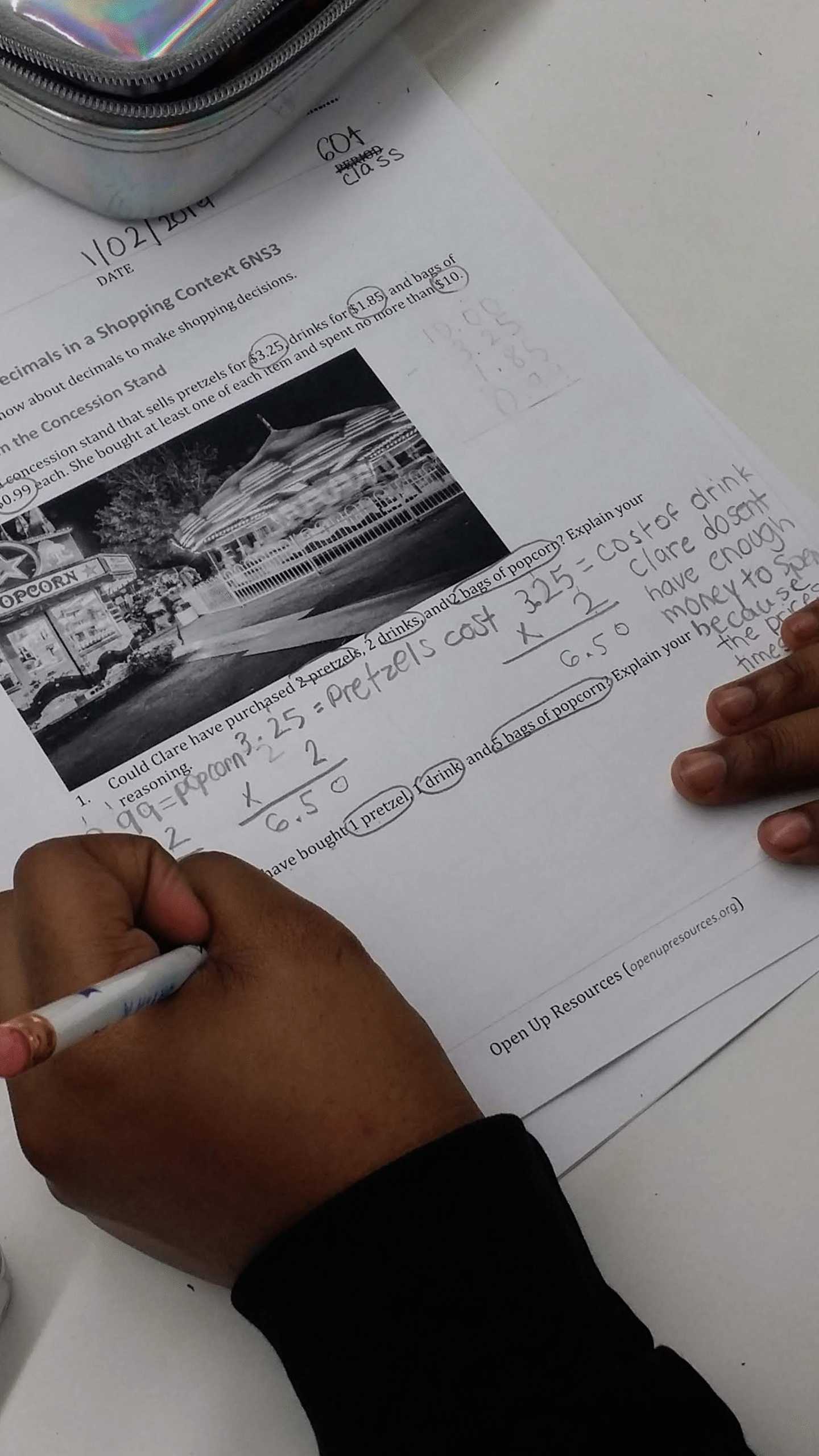
A student engaged in reflective problem-solving — evidence of mathematical reasoning through dialogue and writing.
Welcome to the Socratic Minds
The Socratic Mind is our signature approach to learning — a practice where students don’t memorize answers, they discover truth through reasoning, dialogue, and creativity.
We don’t “help with homework.”
We build thinkers who can analyze, interpret, solve, and lead.
Our students learn to:
- Ask deeper questions
- Explain their thinking
- Notice patterns and structure
- Trust their ideas
- Build confidence through inquiry
Every great mind began with curiosity.
At Bien-Aime Institute, we cultivate it.
When students understand why, they excel at how.
Inside the Cognitive Atelier
Where student thinking covers the walls.
Why We Begin With the Socratic Essay
At Bien-Aimé Institute, the Socratic Entry Essay is more than a writing exercise —it is the first step in teaching students how to think, not what to memorize.
Inside the Cognitive Atelier: Where Writing Shapes the Mathematical Mind
- slow their mind down
- notice structure
- build an argument
- explain their decisions
- revise their thinking with evidence
These are the same habits required for mathematical literacy.
Most students are taught to do math, not to think mathematically.
The Socratic Essay flips that.
By developing a voice in writing, students grow the intellectual muscles they need to reason through complex problems, ask deeper questions, and make meaning visible.
From Writing to Mathematics: Literacy is One Skill
When students learn to articulate their ideas in words, they can articulate their ideas in numbers.
- The same foundations appear in both disciplines:
- clarity of thought
- precision in language
- logical sequencing
- making claims and supporting them
- anticipating errors and justifying choices
So when a scholar writes a Socratic Essay, they aren’t just practicing humanities —they are building the cognitive architecture that makes rigorous mathematical reasoning possible.
What This Looks Like in Math Class
The student work below is not “show your work.”
It is Rigor & Beauty — the moment when disciplined thinking becomes visible and imagination meets precision.
- You are seeing evidence of:
- pattern recognition
- unit reasoning
- scaling and structure
- abstract ideas grounded in clear models
- students justifying why their solution makes sense
- writing and mathematics merging into one fluent language
This is what happens when students learn to think before they compute.
This is mathematical literacy: reasoning that is precise, expressive, and deeply understood.
The work you are about to see is Rigor & Beauty in practice —the intellectual becoming of a scholar trained through the Socratic Mind.
"Rigor & Beauty"
Real thinking is messy before it becomes masterful.
————
Here, thought is visible.
Every mark, model, and reflection is part of a scholar’s becoming — where precision meets imagination, and effort turns into insight.
Model (Conceptual Understanding)
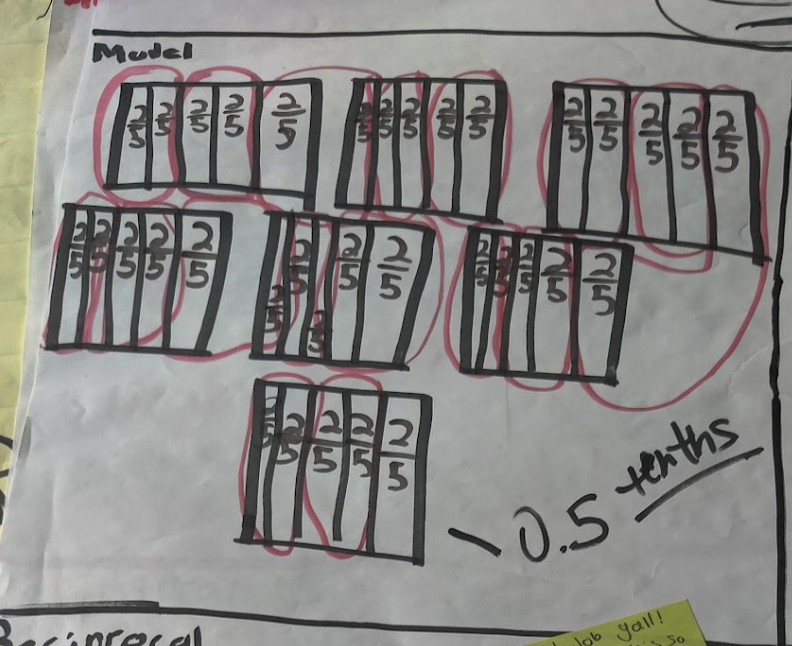
How many 2/5-sized pieces fit inside 7 whole units?
Quad 1: Model – “What does 7 ÷ 2/5 look like?”
What scholars did:
Scholars began by modeling the divisor, 2/5, repeatedly across a whole. They partitioned the bar into fifths, then grouped the units into sets of 2 fifths, counting how many “2/5 chunks” fit into 1 whole and then into 7. At one point, a group labeled part of their work as “0.5 tenths.” The language wasn’t precise, but the thinking was powerful: they were trying to connect fractions, division, and decimals and grappling with the idea that the whole is not an exact multiple of 2/5.
Addressing the misconception:
This is where we slow down and correct gently.
- We use the model to show that 2/5 = 4/10, not “half of a tenth.” Then we connect it back to the whole:
- A whole is 10/10
- Each group of 2/5 is 4/10
- So the whole contains 2.5 groups of 2/5
The misconception becomes a bridge: scholars are already thinking in tenths, so we refine the language and tighten the relationship between 2/5 and its equivalents instead of shutting the thinking down.
Instructional purpose:
Quad 1 builds conceptual understanding before any algorithm appears. Scholars see why the quotient is not a whole number by visually modeling how many groups of 2/5 fit into 7 whole units. The model helps them anticipate that the answer will land between whole numbers, connecting fractions, division, and decimals in a grounded, intuitive way.
- By slowing down and representing the quantities precisely, scholars develop a sense of scale:
- how many fractional units make one whole
- how repeated groups accumulatewhere the “leftover” fractional part comes from
This quadrant positions students to understand every later step. By the time they reach the algorithm, they already know what the answer should roughly be — the computation simply confirms what the model made visible.
Apply Algorithm (Structured Number Work)
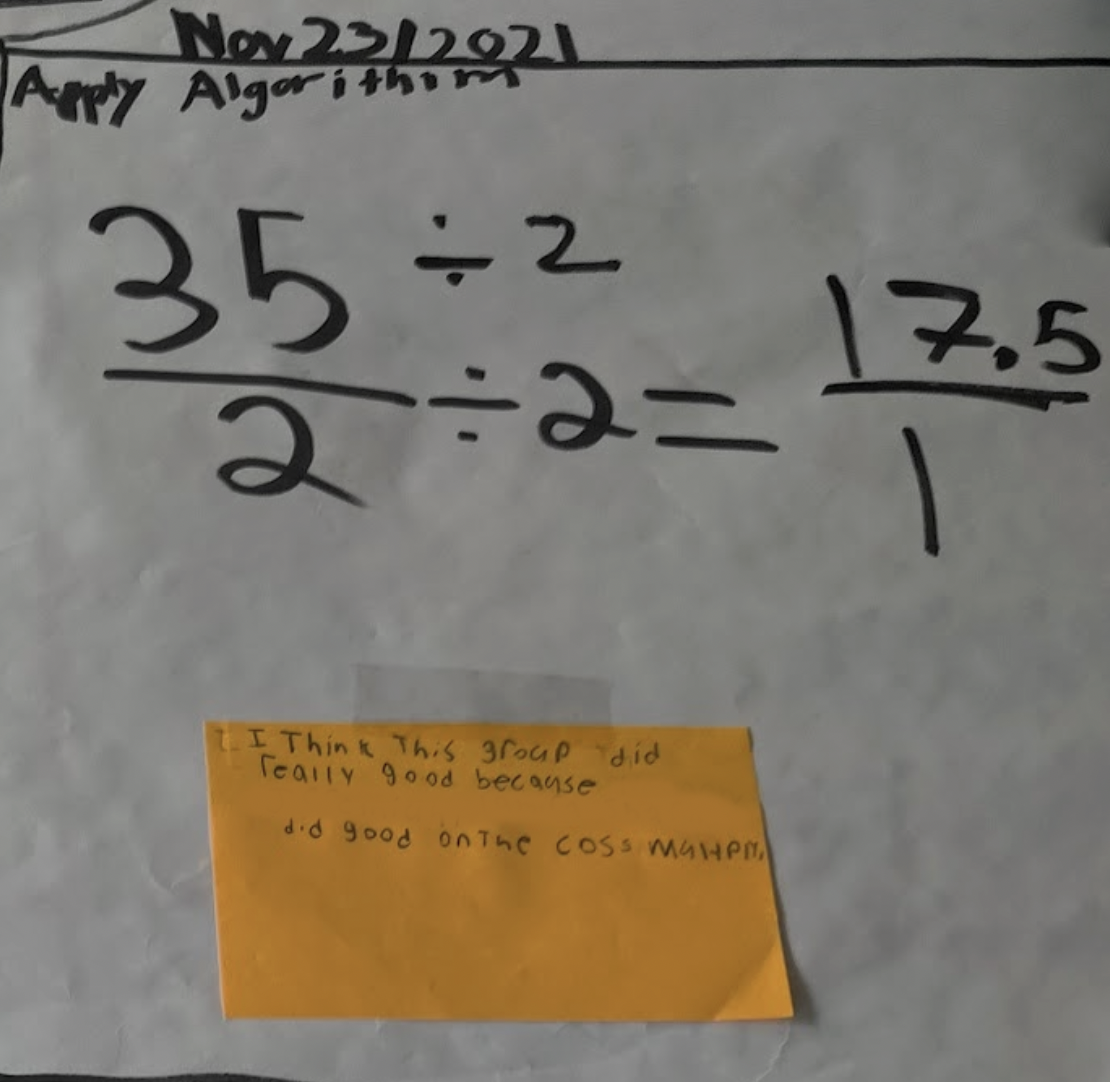
Quad 2: Apply the Algorithm – Scaling First, Then Dividing
What scholars did:
Scholars rewrote the problem in a way that felt friendlier to them. They multiplied both 7 and 2/5 by 5 to clear the fraction:
7 becomes 35
2/5 becomes 2
Then they computed:
35 ÷ 2 = 17
This allowed them to work with whole numbers while still honoring the structure of the original fraction.
Instructional purpose:
Quad 2 develops procedural fluency that stays connected to meaning. By scaling both numbers first, scholars transform a fractional division problem into a whole-number division problem without changing the underlying ratio. This reinforces that multiplication and division can be used strategically to create more workable numbers.
This is not a random trick — it mirrors what they saw in Quad 1: repeated groups, scaling, and anticipating a quotient between two whole numbers.
Quad 2 helps scholars see that procedures grow naturally out of patterns they can already visualize, building confidence and flexibility with rational-number division.
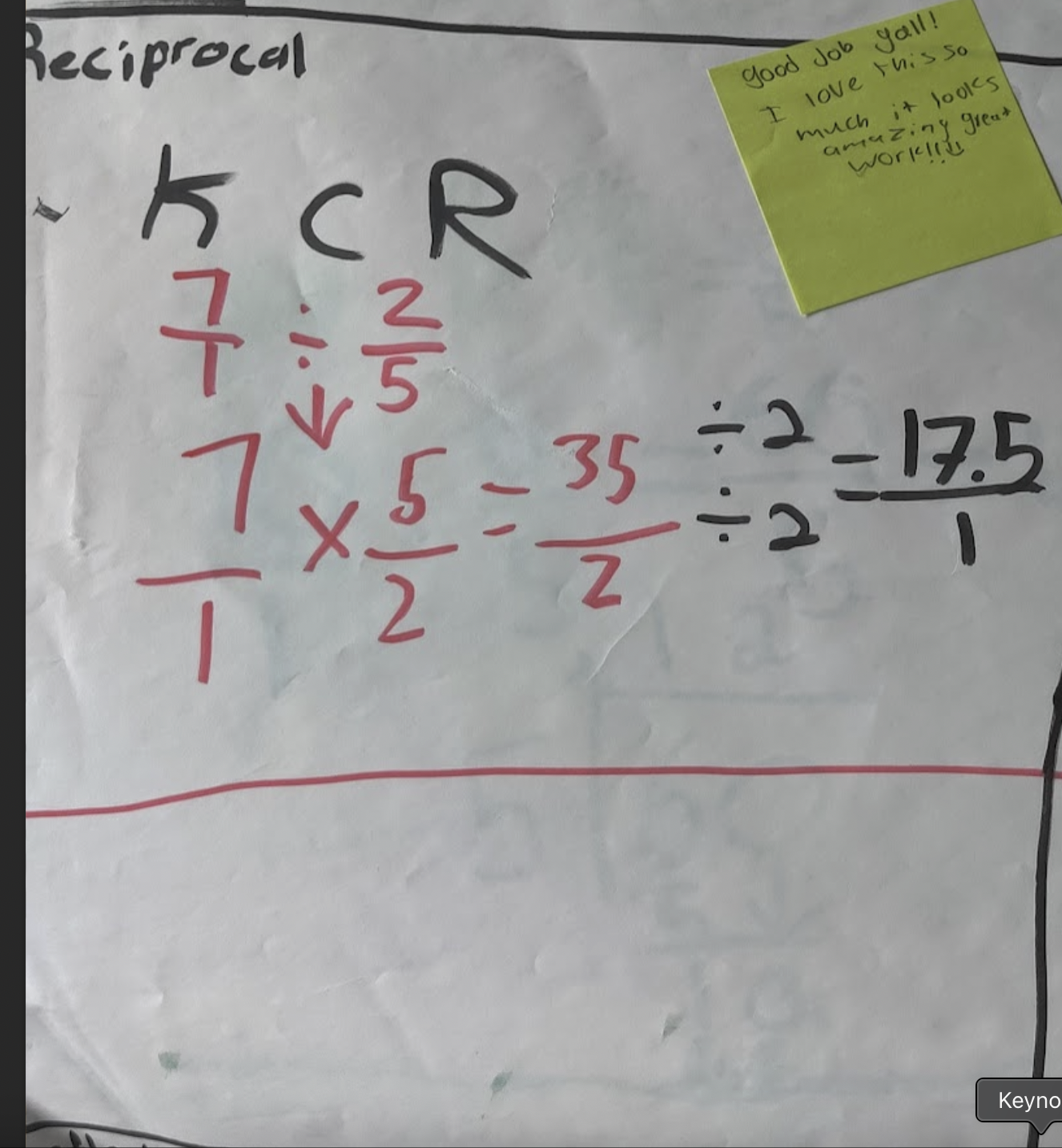
QUAD 3: APPLY THE ALGORITHM — STRUCTURED NUMBER WORK
What scholars did:
Scholars applied the formal division algorithm using the Keep-Change-Reciprocal (KCR) structure. They kept the 7, changed the division sign to multiplication, and replaced 2/5 with its reciprocal, 5/2. This gave them the expression:
7 × 5/2
From there, they broke the expression apart using strategies they already trusted:
- multiplying 7 × 5 to get 35,
- then dividing 35 by 2 to.get. 17.5.
Several scholars naturally cross-checked their thinking with earlier quadrants, noticing that this algorithm produced the same numbers they saw when scaling in Quad 2 and the same number of groups they counted in Quad 1. This helped them see that KCR is not a shortcut from nowhere — it honors the structure of the original problem.
Instructional purpose:
Quad 3 formalizes the algorithm while keeping it deeply connected to meaning.
Students recognize that using the reciprocal is not a magic rule; it is a way of reorganizing the same relationships they have been tracking since Quad 1. KCR becomes an efficient expression of ideas they already understand:
- clearing the fraction (Quad 2’s scaling)
- interpreting groups of 2/5 within 7 wholes (Quad 1’s modeling)
- and maintaining equivalence while simplifying
By the time they reach Quad 3, scholars see that the algorithm isn’t something to memorize — it is something to recognize.
Quad 3 builds true procedural fluency, rooted in understanding rather than rote steps, empowering scholars to choose methods flexibly and justify their reasoning with confidence.
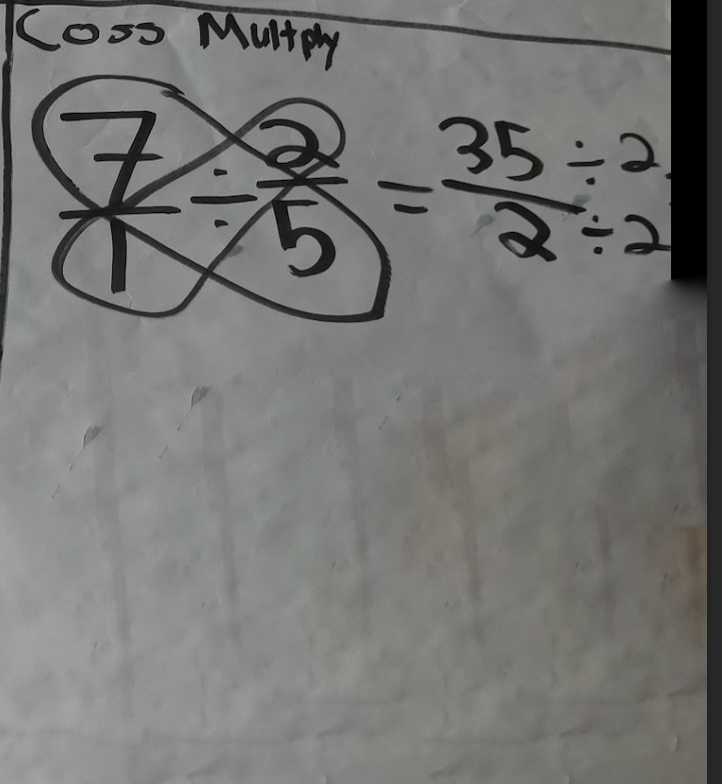
APPLY ALGORITHM (CROSS MULTIPLY METHOD)
QUAD 4: EFFICIENCY — USING STRUCTURE TO REDUCE STEPS
What scholars did:
Scholars used the cross-multiply method to divide the mixed numbers in a way that felt fast and intuitive. Instead of rewriting the problem or clearing the fraction with a common denominator, they relied on a pattern they recognized:
- They crossed the 7 with the 5, multiplying to get 35
- They crossed the 2 with the 1, multiplying to get 2
- Then they computed:
35 ÷ 2 = 17.5
This method allowed scholars to move directly to the quotient without rewriting the entire expression. The structure of the butterfly-shaped model helped them see which numbers pair together and why.
Instructional purpose:
Quad 4 emphasizes efficient reasoning that still maintains mathematical integrity.
The cross-multiply technique isn’t introduced as a “trick,” but as a shortcut that rests on the same relationships scholars saw earlier:
equalizing parts
- proportional scaling
- matching units so division becomes manageable
By the time they reach Quad 4, scholars can notice patterns and choose the method that works fastest because they understand the underlying structure. This reinforces agency: scholars see that math is not about memorizing steps, but about recognizing relationships that let them move fluently between models and procedures.
Get in Touch
Connect With Us
Rooted in Brooklyn. Reaching everywhere, minds grow.
📍 Brooklyn, NY
📞 (240) 257-2831
Find Us Online


More channels coming soon
© 2025 The Bien-Aimé Institute — The Language of Mathematics
All content, teaching frameworks, curriculum tools, designs, student models, and intellectual materials on this site are proprietary to
Magala Bien-Aimé and The Bien-Aimé Institute™.
Bien-Aimé Cognitive Atelier™, Bien-Aimé Language–Mathematics Framework™, Flip-N-Sip™, and related instructional designs are original works.
Unauthorized reproduction, distribution, or adaptation is prohibited.